Imagine the Possibilities of a Pain-free Life / Call Today 833-4-PAIN 800
In the world of physical therapy, there are many treatment methods that can help you to heal. One of those used by our chiropractors is ultrasound therapy.
Ultrasound therapy, also known as therapeutic ultrasound, uses sound waves to treat musculoskeletal and other medical problems. Ultrasound is commonly used to treat inflammation, such as a sprain or tendinitis, after an injury.
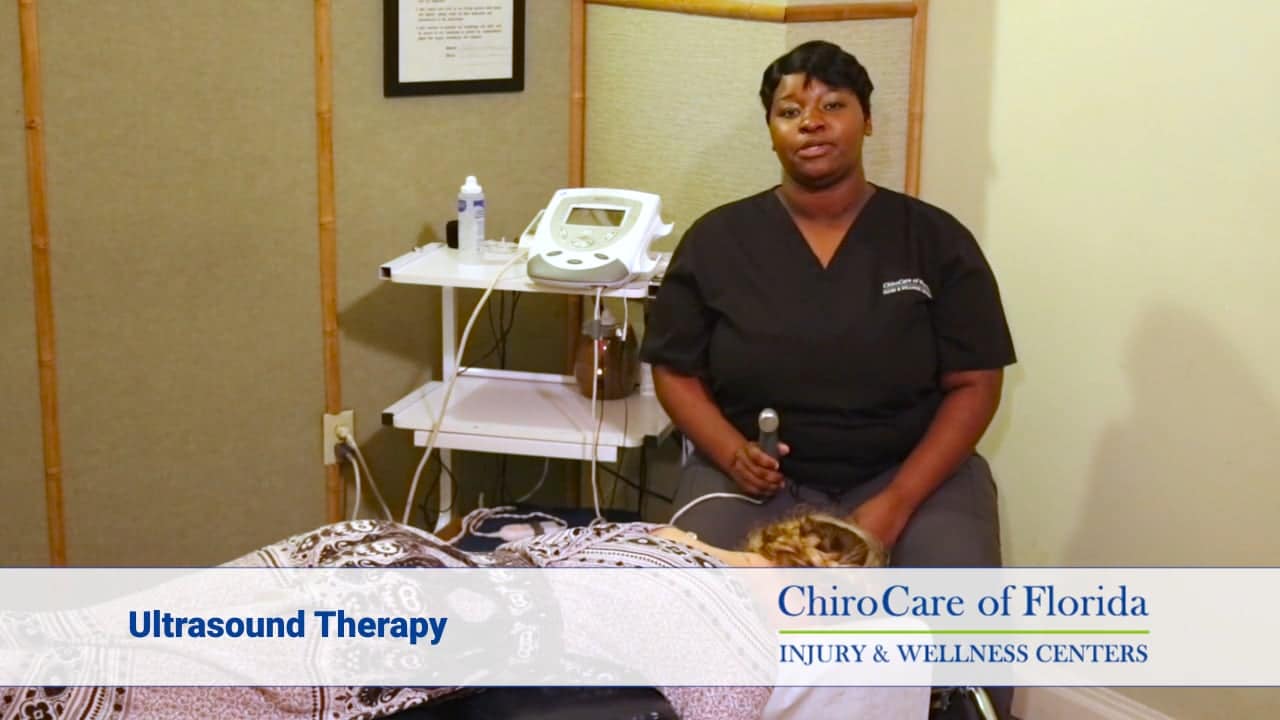
Learn from ChiroCare of Florida staff member Christina how ultrasound works to provide pain relief and decrease inflammation. Watch as she demonstrates ultrasound therapy in our South Florida offices:
Video Transcript:
CHRISTINA: Hello there, my name is Christina.
I’m here with our patient today who is experiencing some upper neck pain on her left side. What I’m about to do is start some ultrasound to decrease the inflammation and also alleviate the pain in the affected area. We normally do this for about 7 minutes. And we also do this to help the patient feel relief.
We look forward to having you here at ChiroCare of Florida.
If you’re unfamiliar with physical therapy, you might be confused to hear the term “ultrasound” involved with treatment. However, if you have received physical therapy in the past, you’re most likely very accustomed to the use of ultrasound therapy as part of your chiropractic treatment.
Ultrasound technology emits sound waves above the audible range of human hearing. Waves created by electrical equipment force a material to vibrate with an incredibly high frequency – a frequency that we could not produce manually. The faster a material can vibrate, the higher frequency of the sound waves that it emits.
We utilize ultrasound equipment in a variety of fields, from ultrasonic detection in ships, to testing for flaws in airplanes. However, chances are you are most familiar with using ultrasound in the medical field.
When used in physical therapy, ultrasound technology provides deep heating to soft tissue, including muscles, joints, ligaments, and tendons. Ultrasound wave vibrations increase tissue temperature and circulation, helping to alleviate pain. During ultrasound therapy, deep heating provides a warming sensation to afflicted areas.
Deep heating tissue also aids in releasing tension in tight muscles and tendons. This can be especially useful if you are remodeling scar tissue that has little to no elasticity or mobility. Your physical therapist can utilize ultrasound to improve the stretch of tissue and help to sustain tensile forces. Therapeutic ultrasound soothes sore muscles, and boosts healing.
Aside from deep heating, ultrasound therapy has non-thermal benefits as well. During ultrasound therapy, an ultrasound transducer helps flood the body with energy. This energy catalyzes an effect called cavitation, in which microscopic gas bubbles surrounding soft tissue expand and contract rapidly.
Cavitation is believed to aid cellular processes, which aid in healing injured tissue. When incorporated into a wellness plan, this treatment assists in alleviating pain as well as working to ensure a quicker healing time.
In most cases, ultrasound therapy can be used to treat ailments such as:
To administer ultrasound therapy, your physician will place a small amount of gel on the injured area and begin to slowly move the head of a transducer in small, circular motions around the body.
Ultrasound units are equipped with various settings that your physician can alter based on the level of depth he or she wishes the ultrasound waves to penetrate. These settings will vary as you progress through physical therapy sessions. If there is inflammation present, your physician may opt to use a topical medication while performing a therapeutic ultrasound to treat the swelling around the soft tissue.
Make an appointment for ultrasound therapy at an office near you: